
Day 776: The "Post" Effect
The "day after" has finally arrived, but it's a bit more confusing than I expected.
Finally.
The truce has been in effect for five weeks, but only yesterday could I finally say the war is over.
After two years, I’m thrilled to report that B is out of a combat zone. Having completed his second role as signals corps officer, he will serve as an instructor at the officers training academy.
Only last week, Y completed the first phase of the officer’s training course in that same base.


So how are things?
I’m sleeping better. I’m able to focus a bit more, and I’m slowly letting go of the compulsion to check my phone in the middle of the night. A possible trip abroad no longer sounds crazy or decadent. And maintaining a demanding job while balancing the changing needs of our family seems no longer feels impossible.
It’s not really over, though. There are still troops inside the yellow line in Gaza, and terrorists are still barricading in the tunnels underneath Raffah. Other ceasefires, particularly withHezbollah and Iran, are less stable than we’d like. Contrary to what you might have heard, there is no “Peace in the Middle East.” At least not yet.
There are three Israeli hostages in Gaza: Ran Gvili, Sudthisak Rinthalak and Dror Or. This morning, I listened to an interview of Alma Or, the teenage daughter of the latter. Two years after becoming orphaned —her mother was also murdered on Oct 7— and having been being abducted to Gaza with her brother— Alma still can’t begin the mourning process.
At the same time, much of the country has moved on. Political debate and new scandals rule the airwaves. ElAl airfares have gone down considerably, now that the foreign airlines have all returned. Tourists are returning. We are expecting visitors soon (an opportunity to make up for their last visit in June, which was cut short by scurrying out of the country via Jordan when the war with Iran began.)
The NGOs that were created during the war are also changing. The Saturday night rallies from the Hostages Families Forum are expected to stop at the end of the month. The silent protests organized by Mishmeret 101, are now “taking a break to recharge.” The instagram account of “Bring Gali and Ziv Home” that happily became “Ziv_and_Gali_are_Back_Home” had a message encouraging its followers to follow each of the twins directly (although it still seems to be active, especially since they are in the midst of a crowdfunding campaign to secure their ongoing rehabilitation.)
Moving on. And at the same time, a lingering sense of sadness. Of loss.
Memorial stickers still cover the walls of every public space imaginable, from shop windows to hospital entrances, and from bus stops to army bases. Every fourth post on my Facebook seems to feature a memory, or a wedding speech or crowdfunding campaign for a young woman or man killed in the war. NGOs dealing with mental health have launched awareness campaigns in the media.
Even the bragging of my running coach becomes a moment of reflection. Posting a video of his son’s band during a local tribute to Queen, he wrote, “At last, he’s holding a guitar, not a weapon.”


And now what?
A friend texted me this week:
“I’m kinda feeling ‘post’… right now. Post-war, post-wedding…” [one of her children got married a few months ago.] “Do you know of any places I can volunteer this week?”
She didn’t say post-trauma, because none of us feel we are entitled to such a term, word but I’m beginning to wonder what we’re so afraid of. Because we know the tsunami of mental health crisis is coming.
Even after the war is over, at least officially, we find ourselves in new territory. The constant doing of the last two years did not culminate in a final sigh of relief and relaxation. It certainly did not end in a euphoric, post-war celebration.
What we are feeling is more akin to feeling lost in a dull, confusing fog.
Things did not return to “normal” — living in a world where being Israeli was simply seen as yet another nationality. Israelis (and from what I hear from everyone I speak to, Jews in general) feel an overt or covert sense of persecution. Inside the borders of my country. And beyond.
And then there’s the reckoning. Of trying to string together a story, not just of the long line of events of the past two years, but of the next chapter. What kind of nation do we want to be? What kind of leaders can bring us there? What could have we done differently? What is our role in the world? How can we achieve peace with the Palestinians? With the world?
What’s Next
This morning I spent a good five minutes looking at the newly formatted “war infographic” of the Kan broadcast company. What used to be a long carrousel of photos switches now only between the photos of three hostages.
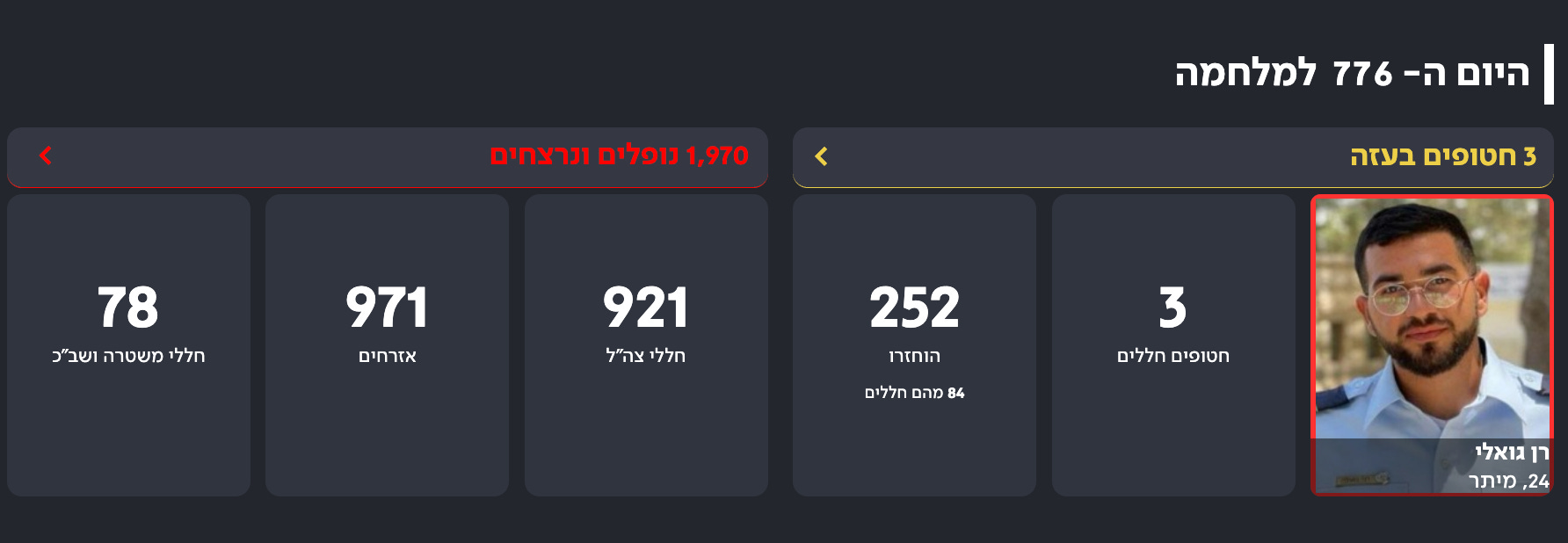
It also features several other stats:
252 hostages returned; 84 of them no longer alive.
1970 casualties:
921 IDF soldiers
971 civilians
78 members of police and intelligence services
Each number tries to tell a story. But is this the best we can do to summarize a war?
I wonder what we’d need to fully capture the lives destroyed, the livelihoods changed. The thousands of missiles launched at civilians? The buildings demolished? The tens of thousands of dead Gazans? The tunnels still in use by Hamas? The hearts hardened, the slurs and accusations hurled at Jews around the world? The divisive declarations by members of my government (and by other world leaders?)
I’m grappling with these questions as I work on a memoir of my year volunteering with war veterans. Among the privileges of witnessing the (physical and mental) rehabilitation process up close is the fact you get an early seat at the table of “the day after.” One of the most difficult issues for my students, whether they voiced it directly or not, was their changing identity: Who were they now? Former soldiers? New civilians? Disabled citizens? Patients? Future amateur sportsmen or students or businesspeople? Fathers and husbands and boyfriends and uncertain of their role when they return home?
This same stage is the one we are reaching as Israelis today. As private citizens, and parents of soldiers, or civilians, or minors. As global citizens concerned at the growing populism and discourse of hate around the world. And as a divided people who nonetheless proved that, in a time of need, we went above and beyond to help each other.
In a time when my government continues to weaken democracy and attacks the press, aims to evade an official inquiry, and sows more hatred and division, we can’t rest on our laurels. We need to stay strong, and work on building something better. As long as we are willing to and ask the tough questions, we should be on the right path.
Hooray for B's new role!!! And ditto to everything else...